

Table of Contents
- Why Your First Fire Damage Settlement Offer Is Never the Final Number
- How to Document Fire Damage for Insurance: Building an Irrefutable Claim File
- What Not to Say to a Claims Adjuster During Settlement Talks
- Hiring a Public Adjuster for Fire Claims: When It Pays Off
- Fire Damage Insurance Claim Timeline: What to Expect and When to Push
- Negotiation Strategies: Counteroffers, Appraisal Clauses, and Bad Faith Use
- Conclusion: Managing Decision Fatigue and Securing Your Best Outcome
- Frequently Asked Questions
Last Updated: October 4, 2026
Why Your First Fire Damage Settlement Offer Is Never the Final Number
The first number your insurer sends is an opening bid, not a verdict. Policyholders often accept far less than their policy owes.
Insurers calculate your payout using actual cash value (pre-fire worth, after depreciation) unless your policy specifies replacement cost (today’s rebuild or rebuy prices). That gap widens as your home ages.
The Gap Between Actual Cash Value and Replacement Cost
A ten-year-old roof does not cost ten-years-ago prices to replace. Many policies pay actual cash value up front and release the replacement-cost difference only after repairs are complete and receipts submitted, recoverable depreciation. Policyholders who never file that second claim forfeit the difference.
Accepting an actual cash value check without reading your policy’s replacement-cost provision is a common and expensive mistake. You may be legally owed thousands more that the insurer will never volunteer.
Read your declarations page and coverage limits before responding to any offer.
How to Document Fire Damage for Insurance: Building an Irrefutable Claim File
Documentation wins claims. A well-built file turns a disputed number into a settled one, starting the day of the fire.
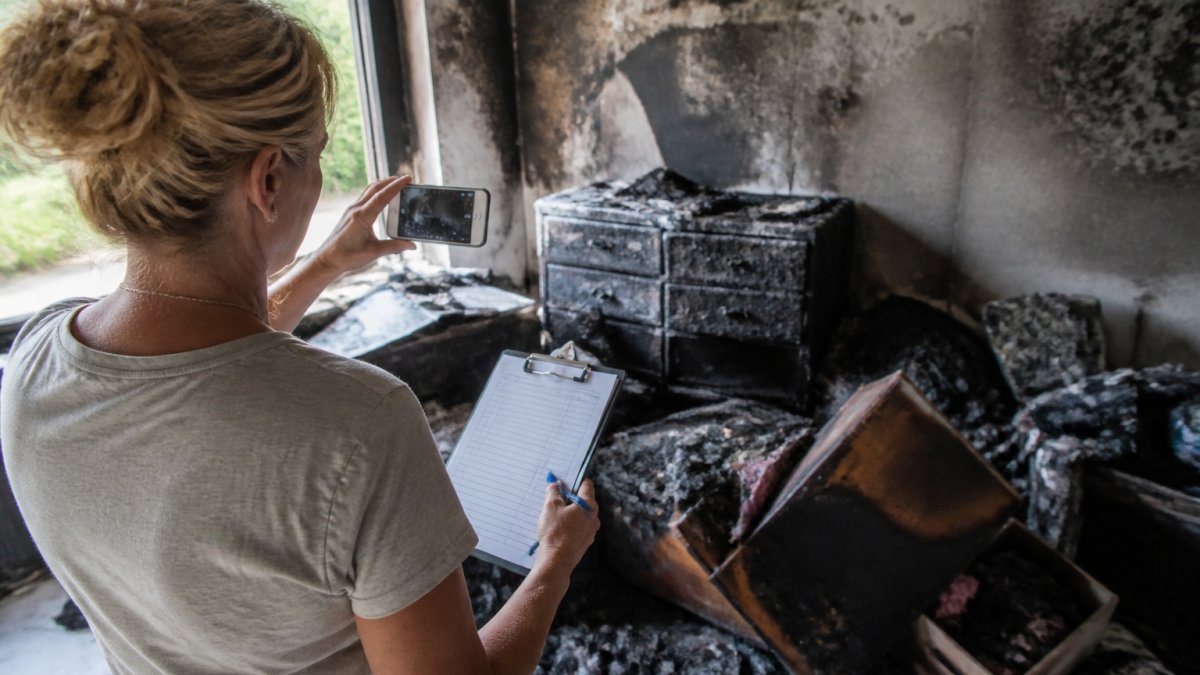
Photograph everything before cleanup: wide shots for the room, close shots for serial numbers, brands, and model plates. Keep damaged items until the adjuster sees them, unless they pose a health hazard.
Preserving Charred Evidence and Smoke Damage Proof
Smoke damage is invisible in photos but real in cost: soot corrodes electronics, stains porous surfaces, and leaves odor requiring professional remediation. Document it with dated photos, a room-by-room log, and mitigation receipts.
Digital Tools and Inventory Software That Speed Up Valuation
Inventory software replaces the spiral notebook. Apps that photograph an item, log its purchase date, and attach a receipt create a proof of loss package that is hard for an adjuster to discount. Build it room by room and back it up to the cloud.
What Not to Say to a Claims Adjuster During Settlement Talks
Every word to a claims adjuster can reduce your payout, they record casual statements as admissions. Stay polite, factual, and narrow.
Avoid these phrases entirely:
- “It’s probably not that bad.” You have just capped your own claim.
- “We were planning to remodel anyway.” Now the damage looks like an upgrade, not a loss.
- “I don’t have receipts.” You have conceded the valuation argument.
Answer only what you are asked and volunteer nothing. You can decline a recorded statement and request it in writing. If a question touches cause, fault, or prior condition, get advice first.
Hiring a Public Adjuster for Fire Claims: When It Pays Off
A public adjuster works for you, not the insurer, documenting your loss, interpreting your policy, and negotiating the settlement offer on your behalf. For complex or large fire losses, that representation frequently changes the outcome.
You do not need one for every claim, a small, clear kitchen fire may settle fine on your own. Barclays Public Adjusters operates on a No Recovery, No Fee basis, so you owe nothing unless we recover funds for you.
Ask any public adjuster for their license number and confirm it with your state’s insurance regulator before signing. A legitimate adjuster will hand it over without hesitation.
Fire Damage Insurance Claim Timeline: What to Expect and When to Push
Timelines vary by state and policy, but the sequence does not. What separates a settled claim from a stalled one is knowing which stage you are in and where the insurer must legally move. Most states impose a prompt payment statute or unfair claims settlement practices act setting outer limits on acknowledgment, investigation, and payment. Day counts differ, often acknowledgment within 10 to 15 days, a decision within 30 to 45 days after proof of loss, and payment within 5 to 10 business days after agreement, but the pattern is consistent enough to plan around.
| Stage | What Happens | Typical Window | When to Push |
|---|---|---|---|
| Report the loss | You notify the insurer by phone and in writing | Within days of the fire | Same day; confirm in writing |
| Acknowledgment | Insurer confirms receipt and assigns a claim number | 10-15 days in most states | If no written acknowledgment arrives |
| Adjuster inspection | Carrier sends a field adjuster to assess damage | Within 1-2 weeks of reporting | If inspection is delayed past 2 weeks |
| Proof of loss | You submit your sworn, documented inventory | Before the insurer’s stated deadline (often 60 days) | Request an extension in writing if needed |
| Initial offer | Insurer issues its first settlement number | 30-45 days after proof of loss in many states | Never accept without line-by-line review |
| Negotiation | Counteroffers, appraisal, or dispute resolution | Open-ended, but track every response date | If the insurer goes silent past its statutory window |
| Payment | Funds issued after agreement | 5-10 business days after agreement in most states | If payment is late, cite the prompt payment statute |
Why the Clock Matters More Than the Calendar
A fire claim is not a passive waiting game. Every stage has a trigger, and the insurer’s obligations are tied to your actions. Submit a proof of loss on time and the decision clock starts; skip it and the claim can sit indefinitely without violating anything.
The single most important timeline move is submitting a complete, sworn proof of loss early, it converts your claim from an open file into a deadline-bound obligation.
If your insurer misses a statutory deadline, do not assume it will self-correct. Document the date, cite the relevant state statute in writing, and request a written explanation for the delay. That paper trail is what supports a later bad faith claim.
When to Escalate in Writing
Verbal follow-ups rarely move a stalled claim; written escalation does. A short, dated letter restating the claim number, citing the last submission date, referencing your state’s prompt payment statute, and requesting a response within a set number of days creates a record, and insurers route these letters differently because they create potential liability.
Escalate in writing when:
- The insurer misses its acknowledgment window.
- The adjuster inspection is delayed more than two weeks past reporting.
- The insurer requests documents you have already provided.
The Appraisal and Dispute Clock
If negotiation stalls on value, most policies include an appraisal clause: each side hires a competent appraiser, the two select an umpire, and a written agreement by any two of the three sets the amount.
Track the appraisal clock separately. Once you demand appraisal, the insurer’s prompt payment obligations generally pause until the award issues, then resume, knowing that prevents misreading a legitimate delay as bad faith.
Keep a single dated log of every call, email, letter, and submission. When a claim stalls, that log is the difference between a complaint that gets ignored and one that gets a response.
What ‘Reasonable’ Means in Practice
State statutes often use ‘reasonable’ and ‘prompt’ rather than exact day counts, and regulators interpret those words against industry norms, a 90-day silence on a documented claim is treated very differently from a 20-day silence.
When an offer sits unanswered or a claim stalls without explanation, escalate in writing, and if the pattern continues, bring in representation.
Schedule your FREE Claim Consultation today →
Negotiation Strategies: Counteroffers, Appraisal Clauses, and Bad Faith Use
Negotiation is a documented conversation, not an argument. The strongest position belongs to the policyholder with a complete file, a clear policy reading, and a written counteroffer citing both. What most guides skip is the mechanics, how a counteroffer is built, when appraisal beats bad faith, and how strategy shifts between partial and total loss.
How to Build a Counteroffer That Moves the Number
A counteroffer is not a demand letter, it forces the adjuster to accept your figures or explain, line by line, why they are wrong. A strong one has five parts:
- A clear rejection of the offer. State that you do not accept the initial figure and that you are invoking your right to negotiate under the policy.
- Your corrected figure. Give a single total, not a range. Ranges invite the insurer to anchor at the bottom.
- A line-item comparison. Put the insurer’s number and your number side by side for each disputed item, roof, contents, smoke remediation, code upgrades, additional living expenses.
- The evidence for each line. Contractor estimates, receipts, dated photos, inventory logs, and any expert reports.
- A response deadline. Reference your state’s prompt payment or unfair claims practices statute and request a written response within a specific number of days.
A counteroffer backed by contractor estimates and a sworn inventory moves the number more than any phone call: the adjuster’s supervisor can defend a documented payment, but not ignoring one.
Appraisal Clause: When It Helps and When It Does Not
An appraisal clause is a dispute-resolution mechanism built into most homeowners policies: each side hires a competent, disinterested appraiser, the two select an umpire, and an agreement by any two of the three sets the amount.
Appraisal is powerful but narrow: it resolves the amount of loss, what the damage is worth, not coverage, whether the policy pays at all.
Use appraisal for valuation disputes. Use a coverage letter, a complaint to your state insurance regulator, or legal counsel for coverage disputes. Mixing them up wastes months.
Bad Faith: What It Actually Requires
A bad faith claim is not a disagreement about value, it is a claim the insurer failed its legal duty to handle your claim fairly and promptly.
Bad faith is proven with a paper trail: the dated log, the written counteroffer, the cited statute, and the insurer’s silence or boilerplate response. This is where legal counsel matters most, since bad faith remedies, including extra-contractual damages in some states, are not reliably negotiated alone.
Partial vs. Total Loss: Different Negotiation Nuances
This distinction changes your entire strategy.
A partial loss claim argues over scope: which rooms and items are affected, how much smoke remediation is required, and whether code upgrades are triggered.
A total loss claim argues over the ceiling: the coverage limit, loss of use, additional living expenses, and whether the dwelling limit can rebuild at current costs.
| Factor | Partial Loss | Total Loss |
|---|---|---|
| Core dispute | Scope of damage | Coverage limit and total value |
| Insurer’s leverage | Line-item reduction | Policy limits and exclusions |
| Your leverage | Granular documentation | Contractor rebuild estimates, ALE records |
| Best tool | Detailed counteroffer, appraisal | Policy review, legal counsel, appraisal |
| Common trap | Accepting a scope that misses hidden smoke damage | Accepting a limit that will not cover rebuild |
Know which loss type you have before negotiating, the playbooks differ.
The Order of Operations
When an offer is low, work in order: (1) request the line-item breakdown in writing, (2) submit a documented counteroffer with a deadline, (3) if value is the only dispute, invoke appraisal, (4) if the insurer misrepresents the policy or ignores statutory duties, escalate to your state insurance regulator and consult counsel about bad faith. Each step builds the record for the next.
Conclusion: Managing Decision Fatigue and Securing Your Best Outcome
Fire claims exhaust people. By the time an offer arrives, most policyholders are tired enough to sign anything, precisely when a lowball settlement gets accepted.
You do not have to carry this alone. Barclays Public Adjusters provides expert policy evaluation, comprehensive claim documentation, and direct negotiation with your insurer, all under a No Recovery, No Fee policy.
Schedule your FREE Claim Consultation today and let us fight for the settlement you are owed.
Frequently Asked Questions
What should I not say during a fire damage settlement negotiation?
Avoid speculating about the cause, guessing at values, or saying you are desperate to settle quickly. Statements like ‘I think it was old wiring’ or ‘I just need this done fast’ give the adjuster leverage. Stick to documented facts, provide your inventory list and proof of loss, and refer questions about cause to the fire marshal’s report. If you are unsure, say you will follow up in writing rather than improvising on the spot.
What are the signs of a fair fire damage settlement offer?
A fair settlement offer itemizes replacement cost for structure and personal property, includes additional living expenses if you were displaced, and accounts for smoke damage and mitigation costs. It should not rely solely on actual cash value without offering replacement cost recovery. Compare the offer against your own documented inventory and contractor estimates. If the number is significantly below your documented losses, it is a starting point, not a final offer.
Can I negotiate a fire damage settlement without hiring a public adjuster?
Yes. You can submit a counteroffer supported by contractor bids, receipts, and a detailed inventory list. Many policyholders secure better settlements simply by documenting losses thoroughly and requesting the appraisal clause when negotiations stall. However, if your claim was denied, undervalued by a large margin, or involves complex smoke damage valuation, hiring a public adjuster for fire claims often produces a higher net recovery even after their fee.
How long does a fire damage insurance claim typically take to settle?
Most fire damage claims settle within 30 to 90 days after the proof of loss is submitted, but complex cases involving smoke damage, structural integrity assessments, or disputed cause can extend six months or longer. The fire damage insurance claim timeline depends on documentation quality, whether an appraisal is invoked, and how quickly your adjuster responds. Delays often signal a low initial offer, so track every communication and follow up in writing.
What documentation is required to support a fire damage claim?
You need a fire marshal’s report, photographs of charred evidence and smoke damage, a room-by-room inventory list with values, receipts or bank statements for personal property, contractor estimates for repairs, and proof of additional living expenses. Preserve damaged items until the adjuster inspects them. Digital inventory software can help organize photos and values, making valuation faster and reducing disputes over depreciation.
How do public adjusters help with fire damage negotiations?
Public adjusters evaluate your policy for coverage limits and exclusions, build a documented claim file, and negotiate directly with the insurance company on your behalf. They understand valuation methods, appraisal clauses, and bad faith standards. For fire claims involving smoke damage or partial vs. total loss disputes, their involvement often results in a higher settlement offer. Barclays Public Adjusters works on a No Recovery, No Fee basis.