

Table of Contents
- Steps to Take Immediately After Discovering Water Damage
- Stopping the Leak and Mitigating Further Damage
- Plumbing Leak Insurance Claim Documentation: What You Need
- Reviewing Your Homeowners Insurance Coverage and Exclusions
- What to Say to an Insurance Adjuster About Water Damage
- Water Damage Claim Letter Template and Settlement Negotiation
- How Long Does a Water Damage Insurance Claim Take
- Negotiating Your Plumbing Water Damage Settlement Offer
- Frequently Asked Questions
Last Updated: October 5, 2026
Steps to Take Immediately After Discovering Water Damage
The first hours after discovering water damage determine how much you can recover.
Take photos and videos of the water, wet materials, and damage spread, your proof when you file a claim.
Call your insurer within 24 hours, get a claim number, and document the date, time, and name of who took your report.
Start a list of damaged items, furniture, appliances, flooring, belongings, with approximate age and original cost.
Document the water source itself. If a pipe burst, photograph the burst location and any visible damage to the pipe. Insurance companies often deny claims when they can’t verify the cause was sudden and accidental, not gradual wear.
Stopping the Leak and Mitigating Further Damage
Mitigating further damage is your legal responsibility under most homeowners policies; failure to mitigate can reduce or deny your claim.
Turn off water to the affected area; if you can’t find the main valve, call a plumber immediately.
Remove standing water if safe using a wet vacuum, mop, or pump.
Dry the space with open windows, fans, and dehumidifiers.
Move wet carpets, rugs, and furniture to a dry, ventilated spot, they can be salvaged if dried quickly.
Do not throw away damaged items yet. Insurance adjusters need to see the damage before you discard anything. Take photos first, then ask your adjuster if it’s safe to remove items.
Plumbing Leak Insurance Claim Documentation: What You Need
Documentation is the foundation of a strong claim; insurers deny or underpay when evidence is weak.
Keep all invoices and receipts from plumbers or restoration companies, these prove your mitigation costs.
Take detailed photos from multiple angles showing the water damage, wet materials, the leak source, and the water line on walls.
Write a timeline: when you discovered the damage, called the insurer, met the adjuster, and started repairs.
The most important documents are photos, receipts for emergency repairs, and an itemized list of damaged items with original costs. These three items determine your settlement amount.
Reviewing Your Homeowners Insurance Coverage and Exclusions
Your policy determines what damage is covered. Read it carefully before filing a claim.
Most homeowners insurance covers sudden, accidental water damage from burst pipes, walls, flooring, cabinets, and personal property, but coverage varies.
Check your policy’s water damage section for exclusions. Many policies exclude:
- Gradual leaks (water seeping slowly over time)
- Flooding from outside sources (heavy rain, storm surge)
- Sump pump failure
Understand your deductible, what you pay before insurance covers the rest.
Check your coverage limits: if total damage exceeds the policy maximum, you pay the difference.
If your policy is unclear, call your insurance agent and ask them to explain the water damage coverage in writing. Get their explanation in an email so you have proof of what they told you.
What to Say to an Insurance Adjuster About Water Damage
Your adjuster determines your settlement amount, so prepare carefully.
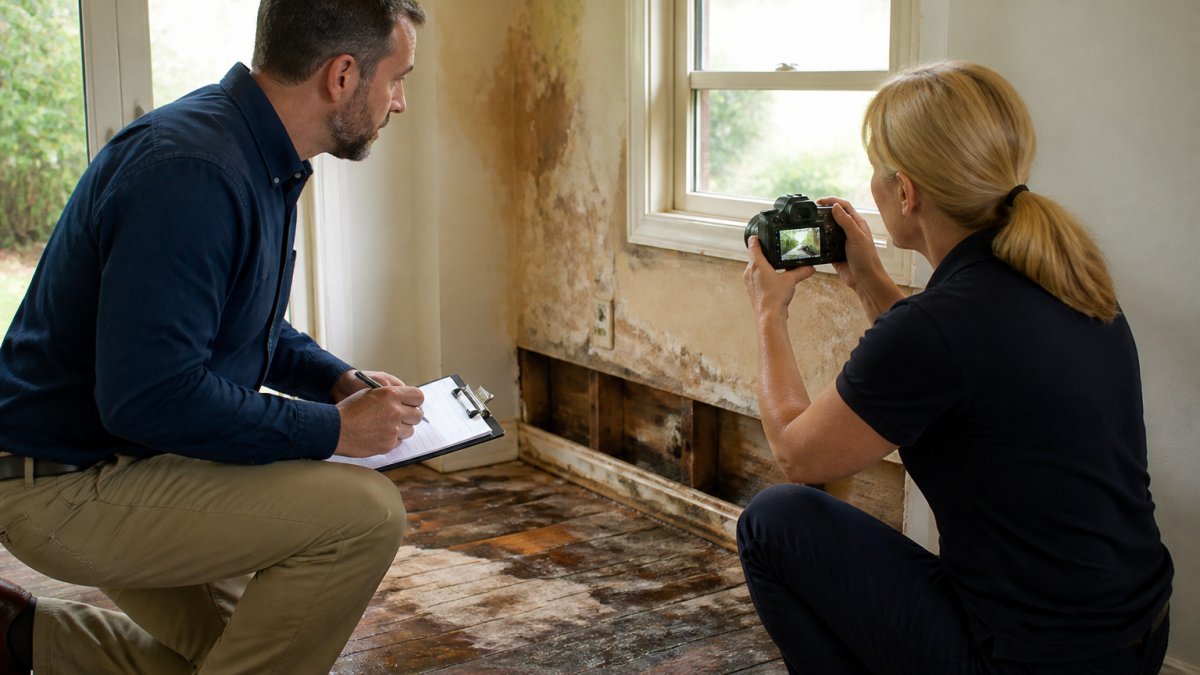
Schedule the adjuster visit within 48-72 hours of reporting, with photos, receipts, itemized list, and timeline ready.
Explain the cause clearly: where the pipe burst and why you think it failed.
Do not accept the adjuster’s estimate on the spot, you have the right to review it, dispute it, and provide your own.
Request a written, itemized estimate showing what is covered and excluded, with exclusions explained in writing.
Water Damage Claim Letter Template and Settlement Negotiation
A formal letter strengthens your position.
[Your Name]
[Your Address]
[Date]
[Insurance Company Name]
Attn: [Adjuster Name]
Claim #[Your Claim Number]
Re: Dispute of Water Damage Settlement Estimate
Dear [Adjuster Name],
Schedule your FREE Claim Consultation today →
I received your estimate for my water damage claim dated [date].
I am providing the following additional information:
Cause of Loss: The damage resulted from a burst pipe in the [location] on [date]. This was sudden and accidental, covered under my policy.
Scope of Damage: Your estimate covers [list what they covered].
Repair Cost Discrepancy: Your estimate lists replacement cost at [amount].
Mitigation Costs: I incurred [amount] in emergency repairs on [date].
I am available to discuss this further.
Sincerely,
[Your Signature]
Send this letter via certified mail so you have proof the insurance company received it. Keep a copy for your records.
How Long Does a Water Damage Insurance Claim Take
There is no single federal deadline for paying a water damage claim. The clock is set by your policy, your state’s insurance regulations, and how quickly you supply documentation.
The typical sequence
| Stage | Typical duration | What controls it |
|---|---|---|
| Report the loss | Same day | Your policy’s prompt-notice requirement |
| Adjuster inspection | 3-10 days after reporting | Insurer scheduling; your availability |
| Initial estimate issued | 5-15 days after inspection | Complexity; whether you provided documentation |
| Your review and counteroffer | 5-10 days | How fast you get contractor estimates |
| Negotiation / revision | 2-6 weeks | Scope disputes; appraisal if needed |
| Payment issued | 5-30 days after agreement | State prompt-payment rules |
| Recoverable depreciation release | After repairs complete | Your submission of final invoices |
A clean, well-documented single-room claim often settles in 3-6 weeks; a whole-floor loss with contents, mold remediation, and code upgrades can run 3-6 months.
Deadlines that actually control your claim
Prompt notice. Most policies require prompt notification. Waiting weeks can give the insurer grounds to reduce or deny the claim, so report within 24-72 hours.
Proof of loss. Many policies require a signed, notarized proof of loss, commonly within 60 days of the insurer’s written request.
Appraisal demand. The appraisal clause usually has no fixed deadline, but courts have enforced the suit-limitation date against late demands, invoke appraisal well before that date.
What slows a claim down
- Missing documentation. Late responses add days; reply within 5 business days when possible.
- Scope disputes. Disagreements on what was damaged stall the claim until you provide contractor estimates or invoke appraisal.
- Contents claims. Submit contents in batches rather than waiting to finish the whole list.
What to do if the claim stalls
- Send a written status request by email, asking for the next step and the responsible person’s name.
- Escalate to the claims manager if you get no substantive response within 10 business days.
- File a complaint with your state’s department of insurance, it’s free and typically forwarded to a senior claims representative.
- Invoke appraisal if the dispute is about the amount, not coverage.
- Consult a consumer-side insurance attorney if the insurer delays without basis, misrepresents the policy, or approaches the suit-limitation date.
Calendar three dates the day you open the claim: the proof-of-loss deadline from the insurer’s written request, your state’s prompt-payment deadline, and the suit-limitation date in your policy. Those three dates, not the average 30-60 day range, determine your leverage.
Do not sign a final release or accept a “full and final” payment on a water damage claim until you are confident the scope is complete. Hidden moisture behind walls and under flooring can surface weeks later, and a signed release can bar a supplemental claim.
Negotiating Your Plumbing Water Damage Settlement Offer
Your settlement is not final until you cash the check or sign a release. Until then, negotiate with line-item math, not emotion.
Step 1: Build a line-item comparison, not a lump-sum complaint
An adjuster’s estimate is written in software (most commonly Xactimate) that breaks the loss into rooms, trades, quantities, and unit prices. Ask for the line-item estimate in writing, then build a three-column worksheet:
| Line item | Adjuster’s estimate | Your contractor’s estimate | Difference |
|---|---|---|---|
| Remove and dispose of wet drywall (sq ft) | $X | $Y | +/- |
| Drywall replacement, 1/2 in., hung and finished | $X | $Y | +/- |
| Luxury vinyl plank flooring, material + labor | $X | $Y | +/- |
| Baseboard, paint, and trim | $X | $Y | +/- |
| Anti-microbial treatment | $X | $Y | +/- |
| Contents cleaning / pack-out | $X | $Y | +/- |
Common omissions to check, room by room:
- Quantities: adjusters often measure only the wet area, not removal needed to reach dry material (e.g., cutting drywall 12-24 inches above the water line).
- Matching: if flooring or cabinetry is discontinued, replacing only the damaged room creates a visible mismatch. Many policies owe for reasonable matching, have your contractor document it in writing.
- Code upgrades: permits, GFCI outlets near water, and wiring upgrades may be owed under ordinance-or-law coverage if purchased.
Step 2: Understand ACV, RCV, and recoverable depreciation
This is the most misunderstood part of a water damage settlement, and it explains why the first check often looks smaller than the contractor’s quote.
- Replacement Cost Value (RCV): today’s cost to replace the item with a new, comparable one.
- Actual Cash Value (ACV): RCV minus depreciation for age and condition.
- Depreciation: the amount withheld based on useful life, a 12-year-old water heater with a 15-year expected life has little depreciation left.
Example: your contractor quotes $9,000; the adjuster pays $6,300 ACV and holds $2,700 in recoverable depreciation. Complete the work, send the paid invoice, and the insurer releases the $2,700, if you never complete the work, you generally don’t receive it.
Step 3: Write a counteroffer that an adjuster can approve
Adjusters approve what they can defend to their supervisor, so give them the paper trail. A counteroffer letter should include:
- Claim number, date of loss, and policy number at the top.
- One paragraph stating what you dispute (e.g., “the estimate omits drywall removal above the water line and undervalues flooring replacement”).
- A line-item table with the adjuster’s number, your number, and your source (contractor estimate, invoice, or published price).
- Attachments: contractor estimate, dated photos, mitigation invoices, and any code citation.
- A specific ask: “I request a revised estimate of $X and release of recoverable depreciation upon completion.”
- A 10-business-day response deadline and a request that any denial be put in writing with the policy language relied upon.
Send the counteroffer by email and certified mail, return receipt requested. Email creates a timestamp; certified mail creates proof of delivery. Keep both.
Step 4: Escalate in the right order
If the adjuster won’t budge, work up the chain rather than jumping to a lawsuit:
- Adjuster’s supervisor or claims manager. Ask for the supervisor’s name and direct line in writing.
- Appraisal. If you and the insurer disagree on the amount (not coverage), each side hires an appraiser and the two select an umpire whose agreement with either appraiser sets the amount, often faster and cheaper than litigation.
- Department of Insurance complaint. Filing a complaint creates a paper trail and often prompts a supervisor review.
Step 5: Know when to bring in a public adjuster
A public adjuster is licensed by the state to represent you, not the insurer, in preparing, filing, and negotiating the claim.
They make the most sense when the loss is large (generally $25,000+), the claim was denied or underpaid after your counteroffer, or you lack the time to build the line-item comparison yourself. They make less sense when the loss is small, the gap is one or two line items, or the insurer has already agreed to the scope.
Never sign a contract with a public adjuster without reading the fee percentage, the cancellation window (many states require a 3-day right to cancel), and whether the fee applies to the entire settlement or only the increase they recover. Ask which one in writing.
Step 6: Document everything
Keep a running claim log with dates, names, phone numbers, and a one-line summary of every conversation. Follow up each call with an email: “Confirming our conversation today: you said X, and I agreed to send Y by [date].” If the claim goes to appraisal, a complaint, or litigation, that log is your evidence.
Frequently Asked Questions
What should I not say to an insurance adjuster about water damage?
Avoid admitting fault, exaggerating the damage, or minimizing it to seem reasonable. Do not say your home was unoccupied for extended periods, as this may trigger exclusions. Never agree to a settlement on the spot or sign documents without review. Stick to factual descriptions of what happened, when you discovered it, and the steps you took to stop further damage. Let your documentation speak for itself rather than making emotional appeals.
Can I negotiate a water damage insurance settlement after receiving an offer?
Yes. You have the right to dispute the settlement offer if you believe it undervalues your losses. Obtain your own contractor estimate, document all expenses related to mitigation and repairs, and submit a written counteroffer with supporting evidence. Many insurers will reconsider their initial estimate when presented with detailed documentation and a professional scope of work. If negotiation stalls, you can request an independent appraisal or involve a public adjuster to advocate on your behalf.
What documents do I need to dispute a water damage settlement offer?
Gather photos and videos of all damage, receipts for emergency repairs and mitigation, a detailed contractor estimate with itemized costs, proof of purchase for damaged items, your insurance policy declarations page, the adjuster’s written estimate, and documentation of any communication with the insurer. Include receipts for temporary repairs, hotel stays if displaced, and any professional assessments. Organize these into a clear packet and submit them with your written appeal or counteroffer to strengthen your negotiating position.
How do I ask for more money in a water damage insurance settlement?
Submit a formal written request with specific evidence: a detailed contractor estimate that exceeds the insurer’s offer, photos showing damage the adjuster may have missed, receipts for undocumented expenses, and a line-by-line comparison of their estimate versus yours. Explain the discrepancies clearly and professionally. Reference your policy coverage limits and cite any exclusions you believe were misapplied. If the gap is significant, obtain an independent appraisal or hire a public adjuster to present a stronger case and negotiate directly with the insurance company.