
Table of Contents
- What the Best Public Adjuster for Commercial Property Actually Does
- Public Adjuster vs. Insurance Company Adjuster: Who Works for Whom
- The Commercial Property Insurance Claim Process, Step by Step
- Commercial Property Damage Claim Documentation That Holds Up
- Public Adjuster Fees: What You Pay and When
- How to Vet the Best Public Adjuster for Commercial Property
- Common Mistakes Commercial Property Owners Make on Claims
- Frequently Asked Questions
Last Updated: October 18, 2026
What the Best Public Adjuster for Commercial Property Actually Does
A public adjuster for commercial property is a licensed advocate who values your loss, builds the claim file, and negotiates the settlement on your behalf. The best public adjuster for commercial property does something narrower and harder than that definition suggests: they rebuild your claim from the policy language up, then defend every line of it.
Below, we break down how the role works, where it differs from the carrier’s side, and how to judge whether an adjuster is worth hiring. The distinction matters because commercial claims carry more moving parts than residential ones: tenant improvements, inventory, lost income, and code-required rebuild costs.
The best public adjuster for commercial property is measured by one thing: whether the documented scope survives scrutiny from the carrier’s engineers and appraisers. Everything else is sales talk.
Public Adjuster vs. Insurance Company Adjuster: Who Works for Whom
The difference is who signs the paycheck. A public adjuster is retained by the policyholder and paid from the recovery. A company adjuster is a salaried or contracted employee of the insurer, and their job is to protect the carrier’s loss ratio.
That single fact shapes everything downstream. The company adjuster controls the initial scope, the reserve, and the first offer. They are not dishonest by default, but they are not on your side either. Many commercial owners assume the adjuster who inspects the property is neutral. That assumption costs them.
A public adjuster reads the policy for coverage grants the carrier’s adjuster may not volunteer, such as ordinance or law coverage, debris removal, or extended business income. Then they document the loss to match.
| Factor | Public Adjuster | Insurance Company Adjuster |
|---|---|---|
| Paid by | Policyholder, from the settlement | Insurance carrier |
| Loyalty | Policyholder only | Carrier |
| Scope of work | Full claim build and negotiation | Initial inspection and carrier-side evaluation |
| Fee structure | Contingency on recovery | No cost to policyholder |
| Best for | Complex, large, or disputed losses | Routine, clearly covered small claims |
Signing a carrier’s proof of loss before your scope is fully documented can limit your recovery. Once a sworn statement is submitted, amending it becomes an argument rather than a correction.
The Commercial Property Insurance Claim Process, Step by Step
The commercial property insurance claim process follows a predictable sequence, and each stage has a deadline that favors whoever is prepared. Here is how we walk clients through it.
- Report the loss promptly. Notice provisions in commercial policies are strict. Late notice gives the carrier a defense.
- Mitigate further damage. Board up, dry out, and keep every invoice. Mitigation costs are usually recoverable.
- Demand a certified policy copy. Read the coverage grants, exclusions, deductibles, and coinsurance clauses before you talk numbers.
- Document the loss completely. Photograph, inventory, and get contractor estimates that include code-required upgrades.
- Submit the sworn proof of loss. Do this only after the scope is built and reviewed.
- Negotiate the scope, not just the number. Disputes usually center on what is included, not the unit price.
- Escalate to appraisal or mediation if talks stall. Most policies include an appraisal clause for valuation disputes.
Timelines vary by carrier and loss size, and complex commercial files can run months. Owners with a leaking roof or a shuttered storefront feel that delay acutely, which is why documentation quality early on shortens the back half.
Commercial Property Damage Claim Documentation That Holds Up
Documentation is where commercial claims are won or lost, and it is the area most owners underestimate. A carrier’s adjuster can only pay what the file supports. Weak evidence produces a weak offer, every time.
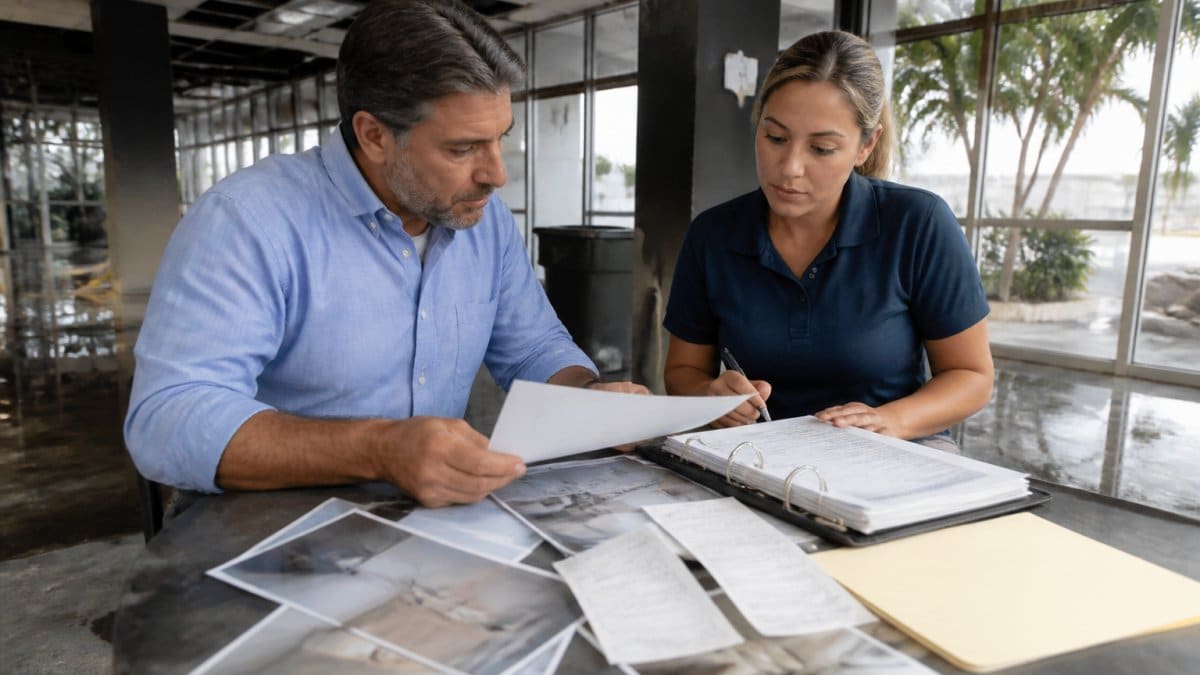
Strong commercial property damage claim documentation typically includes:
- Time-stamped photos and video of every affected area, taken before cleanup
- A room-by-room or unit-by-unit inventory with quantities and replacement values
- Contractor estimates that separate labor, materials, and code upgrades
- Purchase receipts, invoices, and asset schedules for equipment and inventory
- Financial records supporting business interruption: profit and loss statements, tax returns, payroll
- A written narrative tying each loss item to a specific policy provision
What most guides miss is the narrative. A stack of photos is evidence. A narrative that maps each photo to a coverage grant is a claim. Carriers respond to the second one.
Photograph the building systems, not just the visible damage. HVAC ducts, electrical panels, and roof decking often carry smoke or water damage that only shows up in close inspection, and those items are frequently left out of the first scope.
Public Adjuster Fees: What You Pay and When
Public adjuster fees are almost always contingency-based, meaning the adjuster is paid a percentage of the settlement they recover, and nothing if nothing is recovered. This structure aligns incentives: the adjuster earns more when you recover more.
Fee percentages vary by state, loss size, and complexity, and many states cap what a public adjuster may charge. We do not quote a flat figure here because the number depends on your policy, your loss, and the work required. Ask any adjuster you interview for the fee in writing before you sign, along with how expenses are handled.
The fee question owners actually ask is different: “How much more could you get me than the offer I already have?” That is the right question. A contingency fee only makes sense if the documented recovery exceeds what you would have accepted alone. Ask for a realistic assessment of the gap, not a promise.
Barclays Public Adjusters operates on a No Recovery, No Fee basis, so the fee conversation starts and ends with the recovery.
Schedule your FREE Claim Consultation today →
Never sign a retainer that assigns your claim rights or authorizes work without a written fee schedule. Read the cancellation clause too, since most states give policyholders a short window to cancel a public adjuster contract.
How to Vet the Best Public Adjuster for Commercial Property
Vetting comes down to licenses, experience with your loss type, and a documented process. Anyone can claim expertise. Fewer can show you how they build a file.
Use this checklist before you hire:
- Verify the adjuster’s license with your state’s insurance regulator
- Confirm experience with your specific loss type: fire, water, wind, mold, or business interruption
- Ask how they document commercial losses and request a sample claim narrative
- Get the fee percentage, expense policy, and cancellation terms in writing
- Ask who handles negotiation and whether they appear at appraisal
- Request references from commercial clients with comparable losses
- Confirm they carry errors and omissions coverage
The Florida Department of Financial Services license lookup is where policyholders can verify a public adjuster’s credentials. The National Association of Insurance Commissioners publishes state-by-state consumer guidance on adjuster licensing and fee rules. Reviewing both takes minutes and filters out unlicensed operators.
For the contract itself, the Federal Trade Commission’s consumer guidance on service contracts is a useful sanity check on cancellation rights and disclosure.
A common mistake is choosing on personality alone. The adjuster you like most may not be the one who can stand up to a carrier’s engineering report. Ask about their last disputed commercial file and how it resolved.
Common Mistakes Commercial Property Owners Make on Claims
Mistakes cluster around timing and scope, and most are avoidable. The costliest one is accepting the first offer. Initial offers on commercial losses are frequently built on an incomplete scope, and owners who sign early forfeit the chance to correct it.
Other recurring errors:
- Skipping the policy read. Owners file before understanding deductibles, coinsurance, or sublimits.
- Discarding damaged property. Carriers have the right to inspect. Throwing out inventory or equipment destroys evidence.
- Understating business interruption. Lost income claims fail when financial records are thin.
- Handling it alone to save the fee. On large or disputed losses, the gap between a self-built claim and a professionally built one often exceeds the fee.
- Missing deadlines. Notice, proof of loss, and suit-limitation periods are unforgiving.
If your claim was already denied, that is not the end of the road. Denials for wear and tear, maintenance, or excluded perils can be challenged when the documentation shows a covered cause of loss. Overturning a denial depends on evidence, not argument.
Commercial property claims reward preparation and punish delay. If your claim has been denied, underpaid, or stalled, the difference between a fair settlement and a short one usually comes down to how the file was built. Barclays Public Adjusters brings licensed representation, a No Recovery, No Fee policy, comprehensive claim strategy and documentation, and direct negotiation with carriers on your behalf. Schedule your free claim consultation and let our team evaluate your policy and your options before you accept another offer.
Frequently Asked Questions
What does a public adjuster do for a commercial property claim?
A public adjuster represents the property owner, not the insurer. For a commercial property claim, they inspect the damage, build the documentation package, prepare the proof of loss, and negotiate the settlement directly with the insurance company. That includes scoping business interruption losses and code-upgrade costs that policyholders often miss.
How much does a public adjuster charge for a commercial property claim?
Most public adjuster fees are a percentage of the final settlement, set in a written contract before any work begins. The exact rate depends on the size and complexity of the claim, so ask for the fee structure in writing and confirm what happens if nothing is recovered. Barclays Public Adjusters works on a No Recovery, No Fee basis, meaning the fee only applies when a settlement is secured. Request a free claim consultation for terms specific to your property.
Can a public adjuster help with a denied or underpaid commercial property claim?
Yes. A denial is often a documentation or policy-interpretation problem rather than a final answer. A public adjuster can reopen the file, request the insurer’s denial rationale, and submit a documented rebuttal with photos, expert reports, and line-item repair estimates. Underpaid offers get the same treatment: the adjuster compares the insurer’s scope against the actual cost of repairs and negotiates the gap. Reopening a claim takes time, so start as soon as you receive the denial letter.
How do I choose the best public adjuster for commercial property?
Check three things: licensing, commercial experience, and contract terms. Confirm the adjuster holds an active public adjuster license in your state and ask how many commercial claims they have handled, since commercial losses involve business interruption and code upgrades that residential claims do not. Read the fee agreement before signing, including the cancellation window. Ask for references from similar properties. A short consultation should leave you with a clear picture of what the claim is worth and how long it will take.