
Table of Contents
- What Is a Public Adjuster and How They Handle Mold Claims
- How to Document Mold Damage for Insurance Claims
- Identifying Hidden Mold Damage That Insurers Miss
- Policy Exclusions and Mold Caps: What Your Coverage Actually Covers
- Appealing a Denied Mold Insurance Claim
- Public Adjuster Mold Claim Fees and Contingency Structure
- When to Hire a Public Adjuster for Mold Damage
- Frequently Asked Questions
Last Updated: September 27, 2026
What Is a Public Adjuster and How They Handle Mold Claims
A public adjuster is a licensed professional who advocates for property owners during the insurance claims process, negotiating directly with insurance companies on your behalf to secure maximum compensation, and yes, can public adjusters handle mold claims. Unlike insurance company adjusters who work for the insurer, public adjusters work exclusively for you. Can public adjusters handle mold claims? Yes, the complexity lies in understanding what your policy covers and proving the claim’s validity.
Mold claims present unique challenges in the insurance landscape. They’re often denied or severely underpaid because insurers classify mold as a maintenance issue rather than a covered peril. According to the National Association of Insurance Commissioners guidance on water damage and mold coverage, many standard homeowners policies exclude mold damage entirely or cap coverage at a specific dollar amount. This is where professional representation becomes critical. A public adjuster specializes in policy interpretation, documentation strategy, and claim negotiation, three skills that separate successful mold claims from denied ones.
Most homeowners don’t realize that the burden of proof falls on them, not the insurance company. You must demonstrate that the mold resulted from a covered peril (like a burst pipe or roof leak) and that it occurred suddenly, not gradually over time. Documentation collected in the first 48 hours after discovery is worth ten times more than documentation gathered weeks later.
How to Document Mold Damage for Insurance Claims
Documentation is the foundation of every successful mold claim. Understanding the hierarchy of evidence and what to collect within the first 48 hours determines whether claims settle or stall.
The Evidence Hierarchy: What Insurers Actually Value
Insurance adjusters evaluate mold claims using a specific framework: (1) proximate cause, proof that mold resulted directly from a covered peril (burst pipe, roof leak, sudden water intrusion) rather than gradual maintenance failure; (2) contemporaneous documentation collected within 48 hours of discovery, where timestamped photos carry far more weight than those gathered weeks later; (3) professional corroboration from contractor estimates, moisture meter readings, environmental testing, and structural assessments.
The 48-Hour Documentation Window
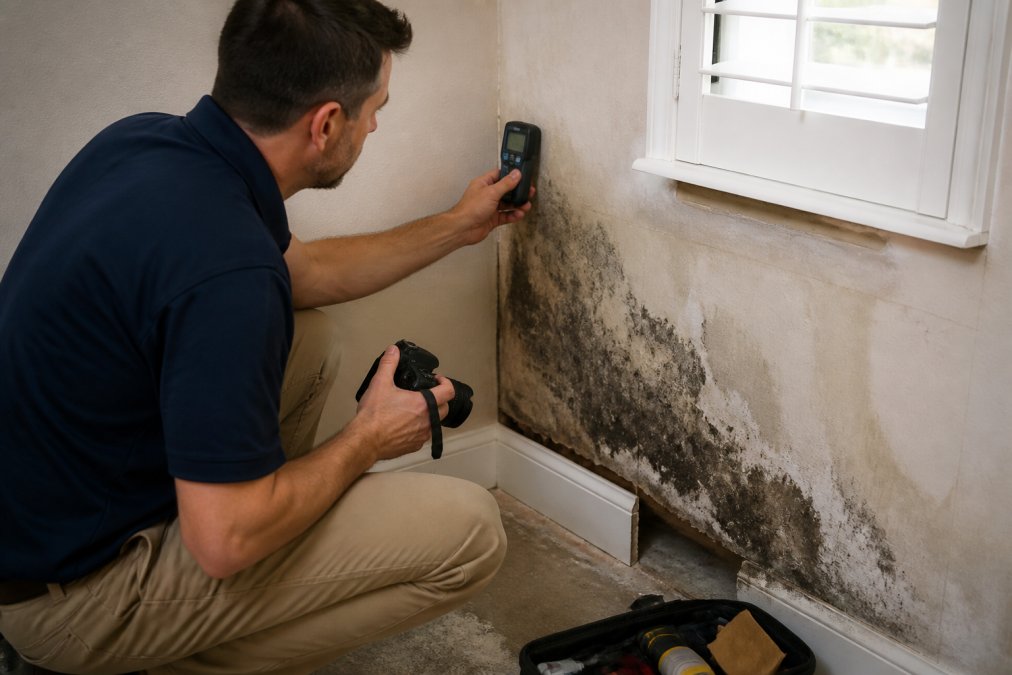
Immediately upon discovering mold, collect: (1) wide-angle and close-up photos of the moisture source and video showing water’s path; (2) photos of mold on affected materials with scale reference; (3) moisture meter readings from affected and unaffected areas; (4) written timeline documenting discovery date/time, preceding weather, and immediate response steps; (5) receipts for emergency mitigation.
The Secondary Documentation Phase (Days 3-14)
Days 3-14, gather: (1) written estimates from three licensed contractors; (2) professional mold inspection report; (3) structural assessment if applicable; (4) all insurance communications in writing, including documentation of adjuster’s inspection scope and any refusals to inspect areas.
The Documentation Checklist: Your Claim Roadmap
Use this checklist to ensure you’ve captured all critical evidence:
- Timestamped photographs of moisture source (roof damage, burst pipe, foundation crack, etc.)
- Timestamped video pans showing water path from source to mold location
- Wide-angle photographs of each affected room
- Close-up photographs of mold on specific materials (include scale reference)
- Moisture meter readings from affected and unaffected areas (photographed)
- Written timeline: discovery date/time, preceding weather/events, immediate response steps
- Receipts for temporary mitigation (dehumidifiers, fans, supplies)
- Three contractor repair estimates (itemized, from licensed professionals)
- Professional mold inspection report (from certified environmental inspector)
- Structural assessment (if applicable)
- Insurance company claim number and adjuster contact information
- Copies of all emails and written communications with insurer
- Photos of adjuster’s inspection (if permitted) showing areas inspected and equipment used
- Documentation of any areas adjuster refused to inspect
- Your homeowner’s insurance policy (full text, including exclusions and limits)
- Proof of policy premium payments (to establish active coverage at time of loss)
Why Documentation Gaps Lead to Denials
Many mold claims are denied because policyholders fail to establish proximate cause or provide complete documentation.
The three-document foundation of a strong mold claim is: (1) timestamped photographs of damage and moisture source collected within 48 hours, (2) contractor repair estimates from licensed professionals, and (3) a written timeline connecting the mold to a specific covered peril. Without all three, insurers have room to deny. The documentation checklist above ensures you capture everything needed to overcome common denial reasons.
Identifying Hidden Mold Damage That Insurers Miss
Insurance adjusters often conduct surface-level inspections, missing hidden mold behind walls, under flooring, and in attic spaces, which often represents 60-80% of actual damage. Request a thorough inspection using moisture detection equipment. If they refuse or conduct only a visual inspection, document that refusal. A public adjuster can demand reinspection and bring independent environmental testing to prove hidden damage; the testing cost is typically recovered in increased settlement.
Policy Exclusions and Mold Caps: What Your Coverage Actually Covers
The Mold Cap: Your Real Coverage Limit
The Mold Exclusion: When Coverage Doesn’t Exist
The Ambiguity Doctrine: Your Legal Advantage
Common Policy Language Patterns and What They Mean
Review your policy for these specific phrases:
“Sudden and accidental” water intrusion: Favorable, covers sudden events but excludes gradual seepage. “Seepage and gradual leakage excluded”: Excludes slow water problems but not sudden events. “Mold coverage excluded except when resulting from covered water damage”: Moderately favorable, mold is covered if underlying water damage is covered. “Mold sub-limit of $X applies to all mold-related losses”: Restrictive, but structural repairs may be claimed under standard water damage limit, not the mold sub-limit. “We do not cover loss or damage caused by mold…except when caused by a covered peril occurring suddenly”: Blanket exclusion with exception for sudden covered perils.
Challenging Your Insurer’s Policy Interpretation
A common mistake is accepting your insurance company’s first interpretation of your policy without question. Carriers have financial incentive to read exclusions broadly and coverage narrowly. A public adjuster provides an independent, legally-informed interpretation. Many policies are ambiguous by design, and ambiguity typically favors the policyholder under state insurance law. Do not assume a denial is final until you’ve had the policy reviewed by a professional.
The Difference Between Mold Coverage and Water Damage Coverage
Before filing a claim, request a written copy of your policy’s definitions of “water damage” and “mold damage.” Ask your insurer in writing whether structural repairs triggered by mold would be covered under water damage or mold coverage. Get their answer in writing. If they later deny the claim citing a different interpretation, you have evidence of inconsistent handling, which can support a bad faith claim.
Appealing a Denied Mold Insurance Claim
If your claim has been denied, the process isn’t over. Most denials can be appealed and many are overturned with proper documentation and legal argumentation. The first step is understanding the stated reason for denial.
Public Adjuster Mold Claim Fees and Contingency Structure
Barclays Public Adjusters operates on a “No Recovery, No Fee” policy. Before signing, ask for the fee percentage in writing and clarify what costs you’re responsible for.
Request a written estimate of what additional recovery a public adjuster believes is realistic based on your specific claim. If they can’t articulate why your claim was undervalued, that’s a red flag. A qualified adjuster will explain the specific gaps in documentation, policy interpretation issues, or negotiation opportunities that justify their fee.
When to Hire a Public Adjuster for Mold Damage
The decision to hire a public adjuster depends on claim complexity, potential recovery size, and your capacity to handle the process. Simple claims may not justify the contingency fee. Complex claims involving hidden damage, policy ambiguities, or initial denials almost always benefit from professional representation.
Frequently Asked Questions
Are mold claims covered by standard homeowners insurance?
Most standard homeowners insurance policies exclude mold damage or cap coverage at $2,500 to $10,000. However, if the mold resulted from a covered peril like water damage from a burst pipe or roof leak, the underlying water damage may be covered, which can trigger mold remediation coverage. The key is proving proximate cause, that the mold stems directly from an insured event. Many policies require prompt reporting and mitigation efforts. A public adjuster can review your specific policy language to identify what coverage exists and build a claim based on how the mold originated.
What’s the difference between a company adjuster and a public adjuster for mold claims?
A company adjuster works for the insurance carrier and aims to minimize payouts. A public adjuster represents you, the policyholder, and works to maximize your settlement. For mold claims, this distinction matters enormously because company adjusters often deny or severely undervalue mold damage, citing policy exclusions or arguing the mold is pre-existing. A public adjuster challenges these denials, documents hidden damage the insurer overlooks, and negotiates aggressively on your behalf. Unlike the company adjuster, a public adjuster has no financial incentive to deny your claim.
Can a public adjuster help if my mold claim was already denied?
Yes. A denied mold insurance claim appeal is often recoverable. Denials are frequently based on incomplete documentation, misinterpretation of policy language, or the insurer’s refusal to acknowledge the proximate cause linking the mold to a covered event. A public adjuster can file a formal appeal, submit additional evidence, engage environmental testing experts to prove the extent of damage, and challenge the denial in writing. If the denial was improper or made in bad faith, the adjuster may recommend pursuing additional remedies. Many claims initially denied are successfully appealed with proper representation and documentation.
Do public adjusters charge upfront fees for mold claims?
No. Reputable public adjusters, including Barclays Public Adjusters, operate on a contingency fee basis, meaning they collect a percentage of the settlement they recover for you, only if you receive compensation. There are no upfront fees, no hourly charges, and no out-of-pocket costs for documentation or appraisals. If the claim is not recovered, you pay nothing. This ‘No Recovery, No Fee’ structure aligns the adjuster’s financial interest with yours, ensuring they fight hard to maximize your settlement rather than settle quickly.
Facing a denied mold claim or uncertain about your coverage? Barclays Public Adjusters specializes in maximizing recovery for property owners across South Florida. Our team provides expert policy evaluation, comprehensive documentation strategy, and direct negotiation with insurance carriers. With our “No Recovery, No Fee” commitment, you have nothing to lose and potentially thousands to gain. Schedule your FREE Claim Consultation today to learn what your claim is actually worth.