
Last Updated: November 7, 2026
Quick Summary
Dishwasher leak water damage is often covered when the leak was sudden and accidental, but the dishwasher itself usually is not. Gradual seepage, worn parts, and poor maintenance are commonly excluded. Read your policy and document the damage from the first hour.
- Sudden, accidental failures are generally treated differently from gradual leaks caused by maintenance problems.
- The dishwasher repair or replacement is often excluded, while resulting damage to floors and cabinets may be covered.
- Shut off the water supply, photograph the damage, and keep the failed part if it is safe to remove.
- Compare your deductible and a written repair estimate against the likely payout before filing a claim.
- Insurers may deny claims; request the denial in writing and consider a licensed public adjuster.
Table of Contents
- Why Dishwasher Leak Coverage Depends on How the Leak Happened
- Sudden Leaks Versus Gradual Seepage: The Line Insurers Draw
- What Your Policy Covers: The Dishwasher Itself Versus Resulting Damage
- Dishwasher Leak Floor Damage: Subfloor, Cabinets, and Mold Exposure
- First-Hour Response Checklist and Evidence to Gather
- Deductibles, Claim History, and What an Average Payout Looks Like
- When an Insurer Disputes the Cause or Scope, and Your Next Step
- Frequently Asked Questions
Why Dishwasher Leak Coverage Depends on How the Leak Happened
A dishwasher leak can cause serious water damage to a kitchen. Whether your homeowners insurance pays depends mostly on how the leak started and how long it went unnoticed. ConsumerAffairs water damage insurance claims statistics
Most standard policies cover sudden and accidental water damage. Gradual leaks, worn parts, and poor maintenance are often excluded. The dishwasher itself is usually treated differently from the damage it causes.
Water damage claims are costly. The average U.S. household claim for water damage and freezing exceeds $12,500, so the coverage question matters. ConsumerAffairs water damage insurance claims statistics
Read your policy before you assume you are covered, and document everything from the first hour.
Sudden Leaks Versus Gradual Seepage: The Line Insurers Draw
Insurers do not decide coverage by how bad the damage looks. They decide by what caused the water to escape and how long it was escaping. A supply line that splits during a wash cycle and empties under the cabinet in minutes is the classic sudden, accidental event. A drain hose that has been weeping onto the cabinet base for two months is a maintenance failure, and most standard policies exclude it.
The phrase “sudden and accidental” sounds simple until an adjuster asks you to prove it. In practice, the classification turns on three questions:
- What failed? A pressurized supply line, a cracked inlet valve, or a loose connection can fail without warning. A worn door gasket, a clogged drain, or a hose rubbed through by vibration usually fails slowly and leaves a trail.
- How long was water present? Adjusters look for staining rings, layered mineral deposits, swollen particleboard, and mold growth that takes weeks to develop. Fresh water with no secondary damage reads as sudden. Dried tide lines and soft, crumbly cabinet bases read as long-term.
- What did the homeowner know and when? If you noticed a musty smell or a warped floorboard weeks before the failure and did nothing, the insurer may treat the loss as neglected rather than accidental.
Concrete examples help clarify where the line usually falls:
- Likely sudden: The braided stainless supply line bursts mid-cycle on a Saturday morning. You hear water, shut the valve, and call a plumber the same day. Water is standing but the cabinet base is still firm.
- Likely gradual: The drain hose has been dripping behind the unit for months. The toe kick is soft, the cabinet base is stained in rings, and there is visible mold along the baseboard. The leak was only discovered when the floor gave way.
- Contested: A valve fails, but the cabinet shows old water staining from a prior slow leak. The insurer may pay for the new damage and deny the pre-existing deterioration, or deny the whole claim if it concludes the failure was the predictable result of neglect.
Watch out: cleaning up mold or replacing a soft cabinet base before an adjuster sees it can erase the very evidence that proves the leak was sudden. Photograph and preserve the failed part and the damaged materials before disposal.
Document when you first noticed the water, when you shut off the supply, and what the failed component looked like. Keep the failed hose or valve if it is safe to remove. A plumber’s written opinion that the part failed catastrophically, rather than from wear, is often the strongest piece of evidence in a disputed claim. Water Loss: Settling a Broken Dishwasher Line
What Your Policy Covers: The Dishwasher Itself Versus Resulting Damage
Your policy may pay for the water damage the dishwasher caused. It usually will not pay to repair or replace the dishwasher itself.
These two issues are separate:
- The appliance: Repair or replacement of the failed dishwasher and its parts is often excluded.
- Resulting damage: Floors, cabinets, walls, and ceilings damaged by sudden water may be covered.
Check your policy wording for exclusions and limits. Some policies add endorsements for appliance breakdown, which can change the outcome. Water Loss: Settling a Broken Dishwasher Line
Dishwasher Leak Floor Damage: Subfloor, Cabinets, and Mold Exposure
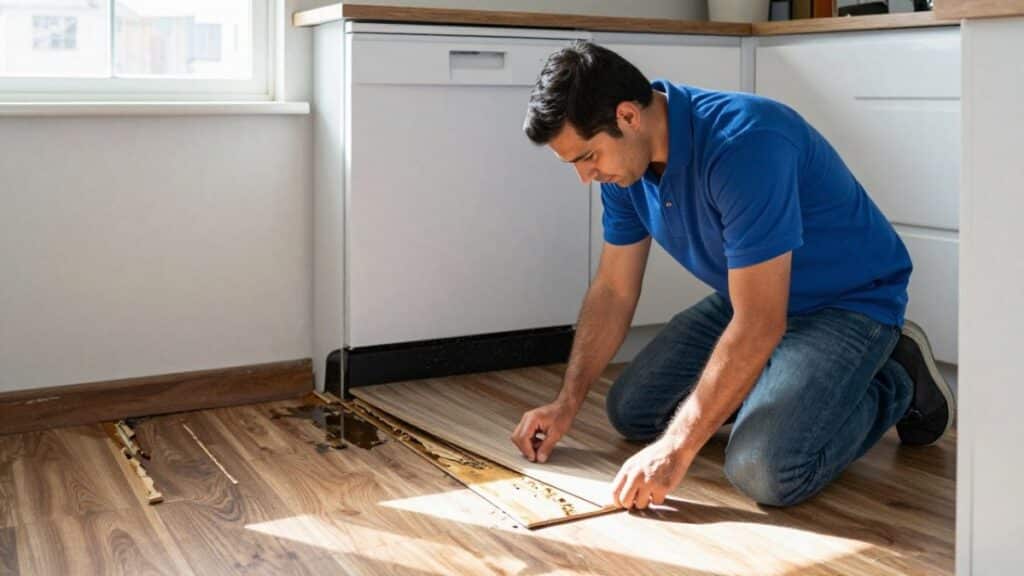
Water from a dishwasher often soaks into the subfloor before anyone sees it. Cabinet bases and the toe kick can rot quietly over time.
Mold is a common secondary problem. Mold can start within days in damp areas. Dry the area quickly and document any growth before cleaning. If you need help with mold claims, see is mold damage covered by insurance.
Flooring and subfloor damage is often where claims get disputed. Keep receipts for any emergency drying or extraction. For guidance on how flood damage claims are supported, see flood damage insurance claim support.
First-Hour Response Checklist and Evidence to Gather
Act fast. Your first hour matters for both the damage and the claim.
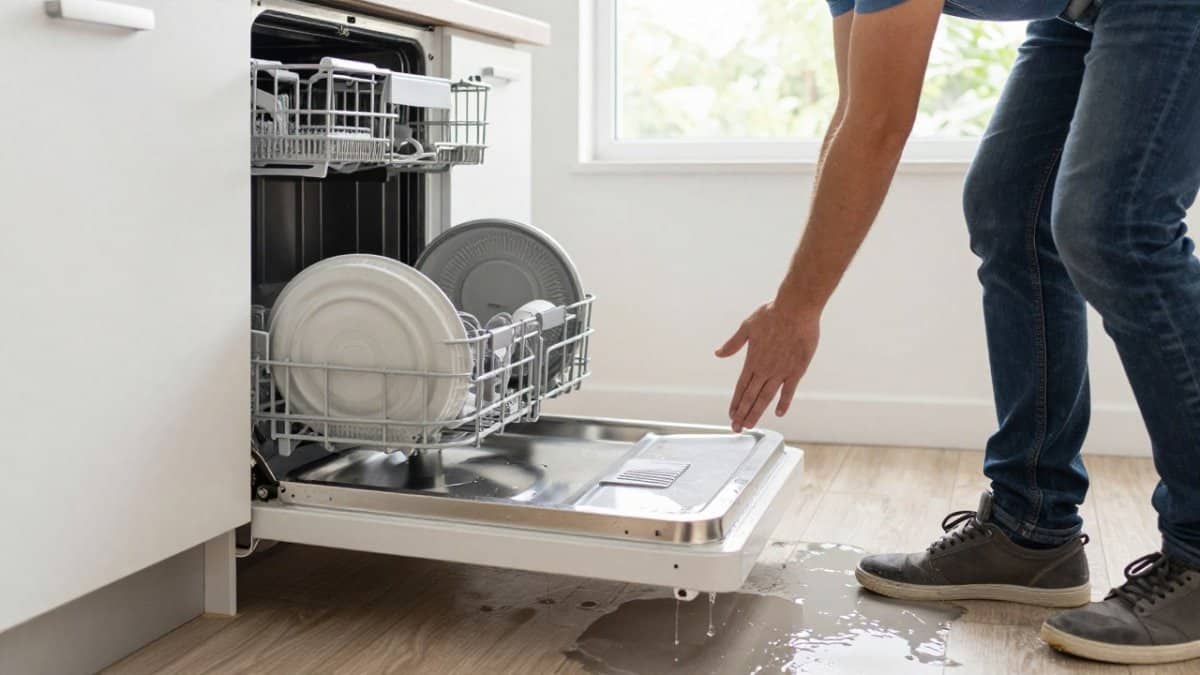
- Shut off the water supply valve under the sink
- Turn off power to the dishwasher at the breaker if water is near outlets
- Photograph the water, damaged areas, and the appliance before moving anything
- Record the date and time you discovered the leak
- Remove standing water with towels or a wet-dry vacuum
- Keep the failed part if it is safe to do so
- Call your insurer and report the loss promptly
Document everything. Save repair estimates, moisture readings, and mitigation invoices. Clear evidence of sudden failure strengthens your claim.
Deductibles, Claim History, and What an Average Payout Looks Like
Filing a dishwasher leak claim is a financial decision, not just a coverage question. Before you call, compare three numbers: your deductible, a realistic repair estimate, and the potential effect on your claim history.
Step 1: Get a repair estimate before you file. A mitigation company or contractor can give you a written scope for drying, flooring, cabinet repair, and any drywall work. Without that number, you cannot tell whether the claim is worth filing.
Step 2: Subtract your deductible. If your deductible is $1,000 and the covered repair estimate is $1,400, you are filing a claim to recover roughly $400. That is rarely worth the claim-history hit. If the estimate is $9,000, the math changes completely.
Step 3: Consider claim history. Insurers may track claims through industry databases, and a water damage claim can follow the property for years. Repeated claims within a few years can affect insurability or premiums at renewal, so weigh your deductible against the likely payout before filing.
Step 4: Separate what is covered from what is not. The failed dishwasher and its internal parts are usually excluded, so do not include appliance replacement in the covered total. Include only the resulting building damage: subfloor, flooring, cabinet bases, drywall, and mitigation.
A common pattern is a mid-four-figure mitigation bill plus a few thousand in flooring and cabinet repair. The average U.S. household claim for water damage and freezing exceeds $12,500, but that figure spans burst pipes, appliance failures, and storm-driven losses, so it is a benchmark rather than a prediction. ConsumerAffairs water damage insurance claims statistics
Watch out: some policies carry a separate, higher deductible for water damage claims than for other perils. Check the declarations page before you assume your standard deductible applies.
If the covered damage clearly exceeds your deductible and you decide to file, report the loss promptly and keep every receipt, estimate, and mitigation invoice. If the damage is close to or below your deductible, paying out of pocket preserves your claim history for a larger event. For a look at how a public adjuster can help with water and mold payouts, see how Barclays Public Adjusters can help with water mold claims.
Before filing, compare these figures to decide whether a dishwasher leak claim is worth making.
| Item | Value | Note |
|---|---|---|
| Average U.S. household water damage claim | Exceeds $12,500 | Spans many causes, so it is a benchmark only |
| Example deductible | $1,000 | Compare against the covered repair estimate |
| Example covered repair estimate | $1,400 | Recovery of roughly $400 is rarely worth the claim-history hit |
| Typical mitigation plus flooring and cabinet repair | Mid-four figures plus a few thousand | Excludes the dishwasher itself |
| Separate water damage deductible | Possible | Check the declarations page |
When an Insurer Disputes the Cause or Scope, and Your Next Step
Insurers sometimes dispute whether a leak was sudden or gradual, or how much damage it caused. A denial or low offer is not always the final answer.
Start by asking for the denial in writing, with the specific policy reason. Compare it against your photos, timeline, and repair estimates.
If the dispute continues, a licensed public adjuster can review the claim and negotiate on your behalf. Barclays Public Adjusters works with South Florida property owners on water damage disputes. For more on this option, see hiring a public adjuster for water damage and flood damage claim support.
Reach out to Barclays Public Adjusters to discuss your claim and the next steps.
Frequently Asked Questions
Is a dishwasher leak typically covered by homeowners insurance?
Often, yes, when the leak is sudden and accidental, such as a supply line that bursts during a cycle. Standard homeowners policies generally cover the resulting water damage to the home. Gradual, long-term seepage is usually excluded, as is the cost to repair or replace the dishwasher itself. Coverage depends on your specific policy wording, endorsements, and deductible, so review your declarations page and report the loss promptly.
Does homeowners insurance cover damage to the dishwasher itself?
Usually not. Most policies treat the appliance’s repair or replacement as a maintenance or wear-and-tear item rather than covered damage. The policy may still cover the water damage the leak caused to flooring, cabinets, and walls. Ask your insurer to separate the two items in the claim so each is evaluated under the correct coverage language.
How do I document a dishwasher leak for an insurance claim?
Photograph the affected area before cleaning or moving anything, including standing water, damaged flooring, cabinet bases, and the dishwasher connections. Keep the failed water supply hose or drain part if you can. Save receipts for emergency water extraction and drying, and record the date you discovered the leak and how long it may have been running. Written notes and timestamped photos strengthen a claim considerably.
Is it worth filing a claim for dishwasher leak damage?
It depends on the size of the loss compared with your deductible. A small repair below the deductible will not produce a payment, but a claim can still be useful for a record. Filing a claim may affect future premiums or claim history, so weigh the out-of-pocket cost against the likely payout before deciding. If the insurer denies or underpays, a licensed public adjuster can review the decision.
