
Last Updated: November 1, 2026
Quick Summary
To calculate the true cost of property repairs, build a line-item estimate covering labor, materials, permits, equipment rental, contingency, and overhead and profit. Adjust the numbers for property age, condition, and region, then compare contractor bids on equivalent scope rather than on total price alone.
- Credible’s 2026 statistics found 64% of respondents said repairs cost more than they expected.
- The American Apartment Owners Association suggests setting aside 1% to 3% of home value yearly for maintenance.
- Get three written bids on the same scope and compare them line by line, not by total.
- Add a contingency line of 10% to 20%, higher for older homes and storm damage.
- Compare the insurer’s estimate with your contractor bids line by line before accepting a settlement.
Table of Contents
- Start With a Line-Item Property Repair Cost Estimate
- Adjust the Numbers for Property Age, Condition, and Region
- Repair Versus Replacement Cost: Which One Belongs in Your Budget
- How to Run a Contractor Repair Estimate Comparison
- Build a Repair Budget Sheet With a Contingency Line
- Where the Property Damage Insurance Claim Estimate Fits In
- Get Your Repair Numbers Reviewed Before You Settle
- Frequently Asked Questions
Start With a Line-Item Property Repair Cost Estimate
Most homeowners guess at property repairs and guess wrong. According to Credible’s 2026 homeownership cost statistics, 64% of respondents said repairs cost more than they expected. A line-item property repair cost estimate fixes that. It breaks every job into labor, materials, permits, and fees, so you see the real number before work starts. Below, we show you exactly how to do it yourself.
The Six Cost Lines Every Estimate Needs
Every repair estimate needs six lines. Skip one and the total will be wrong.
- Labor: hourly rate times hours, by trade
- Materials: quantity times unit price, plus sales tax
- Permits: local fees, which vary by job type
- Equipment rental: lifts, dumpsters, dryers
- Contingency: a buffer for hidden damage
- Overhead and profit: the contractor’s margin
A property repair cost estimate is only as good as its weakest line. Most homeowners forget permits and contingency. That is where budgets break.
Rules of Thumb and Dollar-per-Square-Foot Benchmarks
Rules of thumb give you a starting range, not a final number. The American Apartment Owners Association suggests setting aside 1% to 3% of home value each year for maintenance. Zillow illustrates the 1% rule as $1,800 a year on a $180,000 home.
Dollar-per-square-foot figures work the same way. They help you sanity-check a bid, not replace it. A renovated property needs less; an older one needs more.
Every repair estimate needs these six cost lines, and skipping one throws off the total.
| Cost line | What it covers |
|---|---|
| Labor | Hourly rate times hours, by trade |
| Materials | Quantity times unit price, plus sales tax |
| Permits | Local fees, which vary by job type |
| Equipment rental | Lifts, dumpsters, dryers |
| Contingency | A buffer for hidden damage |
| Overhead and profit | The contractor’s margin |
Adjust the Numbers for Property Age, Condition, and Region
Two identical homes can carry very different repair bills. Age drives wear, condition drives urgency, and region affects price.
A new construction home may need little beyond preventive maintenance. A 40-year-old property often faces roof, plumbing, and electrical replacement at once. Coastal areas add wind and moisture damage to the list.
Here is how we adjust a baseline estimate:
Treat every benchmark as a starting point, then adjust for your property.
Repair Versus Replacement Cost: Which One Belongs in Your Budget
Replacement cost belongs in your budget when a repair will not last. A patch on a failing roof buys months. A full replacement buys decades.
The repair versus replacement cost decision comes down to three tests:
- Age: is the system near the end of its life?
- Frequency: have you repaired it twice in two years?
- Value: does replacement add resale value?
Use replacement costs for systems at end of life. Use repair costs for isolated damage. Getting this wrong inflates or underfunds your budget.
How to Run a Contractor Repair Estimate Comparison
A contractor repair estimate comparison protects you from overpaying, but only if the bids describe the same work. Get three written bids on the same scope, then compare line by line, not by total. The hard part is that contractors format bids differently, so the first job is to normalize them.
Normalize the scope before you compare price
Build a one-page scope sheet that lists every task in the job, then ask each contractor to price against that sheet. A workable scope sheet has columns for task, quantity, unit, material specification, and whether the task is included, excluded, or an allowance. When a bid comes back, map each line to the sheet. Any task a bidder leaves blank is a scope gap, not a discount.
Ask every contractor for the same inputs: labor hours by trade, material specifications (brand and grade, not just “shingles”), permit responsibility, disposal responsibility, and a start and completion timeline. Bids that skip detail are hard to compare. Push back until you get them.
Read the inclusions and exclusions, not the total
Two bids can differ by thousands of dollars and still be for the same work. The difference is usually in what is excluded. Common exclusions that make a bid look cheap:
Schedule your FREE Claim Consultation today →
- Permits and inspection fees left to the homeowner
- Drywall repair and paint after a plumbing or electrical rough-in
- Dumpster and disposal fees
- Temporary protection, cleanup, and final cleaning
- Code upgrades discovered during the work
A bid that excludes three of those items is not cheaper. It is incomplete. Add the excluded items back at market rates before you compare totals.
Test an unusually low bid
When one bid is far below the others, do not assume it is a bargain. Ask the contractor to walk you through the labor hours and material quantities line by line. A low bid can reflect understated labor hours, a lower material grade than the scope specifies, missing scope, or a price that assumes no hidden damage. Ask the contractor to explain the number.
Compare on equivalent scope, then on price
Once every bid is mapped to the same scope sheet and the exclusions are added back, compare the adjusted totals. The lowest adjusted total is the real low bid. The highest is not automatically the safest; it may include allowances or upgrades you did not ask for. The goal is the bid that covers the full scope at a fair price with clear terms.
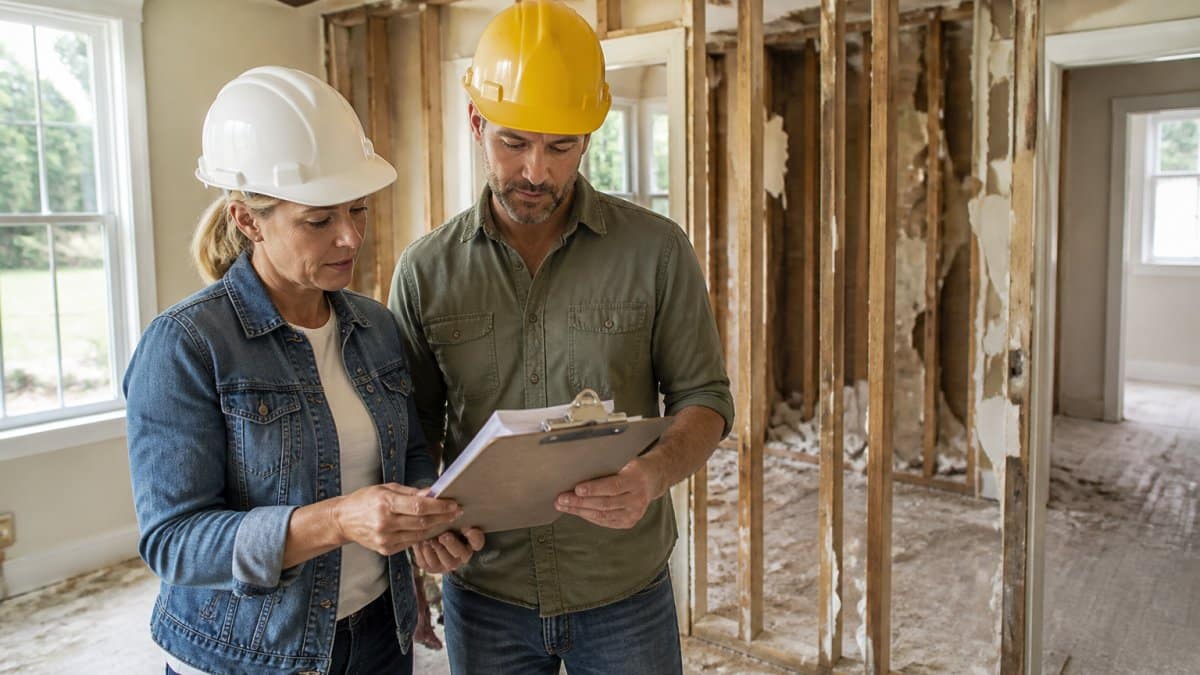
Comparing totals alone hides missing scope. One bid may exclude permits or drywall repair, making it look cheaper when it is not. Always add excluded items back before you rank the bids.
If your insurer referred a contractor, read our guide on whether you can trust contractors referred by your insurance company before you sign anything.
Build a Repair Budget Sheet With a Contingency Line
A repair budget sheet turns estimates into a plan. Build it in a spreadsheet with one row per job and columns for low, likely, and high costs.
Add a contingency line of 10% to 20%. Older homes and storm damage push that higher. The contingency covers what inspection misses: hidden rot, code upgrades, and surprise damage.
Your sheet should track job name and trade, low, likely, and high cost, contingency percentage, and the running total versus your cash set-aside. Update the sheet as bids come in. A repair budget is a living document, not a one-time guess.
Where the Property Damage Insurance Claim Estimate Fits In
Your property damage insurance claim estimate is a separate document from your repair budget, but the two must talk. The insurer’s estimate sets what they will pay. Your contractor bids set what the work actually costs.
When the two do not match, the gap is your problem unless you challenge it. Compare line by line: scope, quantities, and pricing. Missing scope is the most common gap.
To understand how carriers build their numbers, read our breakdown of how insurance companies evaluate property damage in Florida.
Get Your Repair Numbers Reviewed Before You Settle
Before you accept a settlement, put your repair numbers next to the insurer’s offer. If the totals do not match, do not sign. A low offer often reflects missing scope, not a fair valuation.
Barclays Public Adjusters reviews contractor estimates and the carrier’s estimate side by side, documents the gap, and negotiates directly with the insurer. The firm works on a No Recovery, No Fee basis, and its licensed public adjusters handle the back-and-forth so you can focus on repairs.
If your offer looks short, see what to do when an insurance settlement offer is too low. To understand how professional representation strengthens a claim, read how a public adjuster can strengthen your property insurance claim, or browse our public adjuster services to get started.
Frequently Asked Questions
What costs should be included in a property repair estimate?
A complete property repair cost estimate covers materials, labor, permits, code-upgrade compliance, debris removal, and a contingency line. Labor and materials usually make up the bulk, but permits and compliance can add meaningful cost on older homes where current building codes require upgrades during reconstruction. Ask each contractor to break out overhead and profit separately so you can see what you are actually paying for the work versus markup. Missing lines are the most common reason an estimate comes in low and a final bill comes in high.
How much should I budget for unexpected repair costs?
A percentage-of-value reserve is only a rule of thumb, not a prediction for your specific property. A percentage-of-value reserve is only a rule of thumb, and the exact amount depends on the property’s age and construction. For a single repair project, add a contingency line of your own on top of the itemized estimate rather than relying on the percentage alone.
How do I compare contractor estimates for property repairs?
Put every bid on the same scope of work before you compare totals. Ask each contractor to itemize materials, labor, permits, and cleanup, then check whether one bid excludes work another includes. A lower total that omits permit fees or code upgrades is not actually cheaper. Confirm licensing and insurance, and get the scope in writing. Comparing three itemized bids side by side shows you where the real differences sit, which is far more useful than comparing three lump sums.
Does homeowners insurance cover the full cost of property repairs?
Not always. A policy pays according to its terms, limits, and deductible, and it may exclude damage attributed to wear and tear or lack of maintenance. That gap matters because Credible’s 2026 homeownership statistics report that 64% of surveyed homeowners said repairs cost more than expected, while Clever Real Estate reports many homeowners are unprepared for a $5,000 emergency repair. Document damage with photos, receipts, and a written scope before work begins, and review the property damage insurance claim estimate against your policy language.
Storm damage and denied claims put every repair dollar at risk. Barclays Public Adjusters evaluates your policy, documents the full scope of damage, and negotiates directly with your carrier to pursue the maximum settlement you are owed. With our No Recovery, No Fee policy, you pay nothing unless we recover. Get started with Barclays Public Adjusters and schedule your free claim consultation today.
