
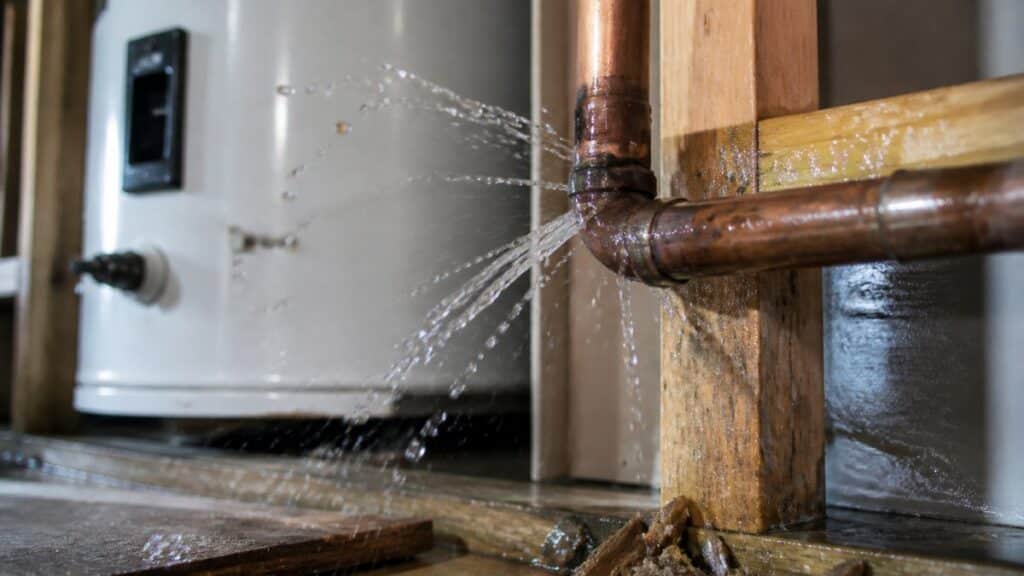
Last Updated: November 4, 2026
Quick Summary
Standard homeowners insurance usually covers the water damage from burst pipes, such as drywall, flooring, cabinets and personal property, but typically not the failed pipe itself. Access and tear-out costs vary by policy, and your deductible and limits determine how much you actually receive. Freeze-related claims may also depend on whether you took reasonable precautions.
- The failed pipe, fittings and plumber’s labor are usually excluded as maintenance.
- Covered water damage is subject to your deductible and dwelling and contents limits.
- Access or tear-out costs are treated inconsistently, so ask your insurer in writing.
- Keep the heat on and insulate exposed pipes to protect a freeze-related claim.
- Photograph all damage and capture the failed pipe before cleanup begins.
Table of Contents
- What a Standard Homeowners Policy Typically Pays For
- Does Homeowners Insurance Cover Burst Pipes From Freezing?
- Does Homeowners Insurance Cover Broken Pipes Under a Slab?
- Does Homeowners Insurance Cover Plumbing Repairs and the Pipe Itself?
- Water Damage Insurance Claim Tips: What to Do in the First 24 Hours
- Documentation, Inspection and Temporary Housing
- Get a Second Set of Eyes on Your Burst Pipe Claim
- Frequently Asked Questions
What a Standard Homeowners Policy Typically Pays For
A standard homeowners policy is built to pay for the water damage a burst pipe causes, not for the failed pipe itself. That single distinction drives most burst-pipe claim outcomes, and it is the first thing an adjuster separates when a claim is opened. The coverage forms treat the plumbing system and the building materials around it as two different things.
On the covered side, a sudden and accidental discharge from a plumbing system typically triggers coverage under the dwelling portion of the policy (Coverage A) for the building materials the water reached: drywall, insulation, flooring, subfloor, ceilings, cabinets, and paint. Personal property (Coverage C) generally responds for furniture, electronics, clothing, and other contents the water damaged, subject to the contents limit and any per-category sublimits.
On the limited or excluded side, the failed pipe, fittings, and the plumber’s labor to repair or replace them are commonly excluded as a maintenance item. The cost of opening a wall, ceiling, or slab to reach the leak, often called access or tear-out cost, is treated inconsistently: some forms pay to open and close the access point as part of the resulting damage, while others exclude it. This is one of the most common points of dispute in a burst-pipe claim, and it is worth asking your insurer in writing before work begins.
Two numbers shape the payout more than any other policy language. The deductible is subtracted from the covered loss, and because water damage claims are frequently in the thousands rather than the tens of thousands, a high deductible can absorb much of the recovery. The policy limit caps the total the insurer will pay; dwelling coverage is usually set near the home’s replacement cost, while contents coverage is a percentage of that amount. A common pattern is for homeowners to discover after the fact that their contents limit is far lower than the value of what was damaged.
Endorsements can change the answer. A water backup endorsement extends coverage to water that backs up through sewers or drains, which a standard form excludes. A service-line endorsement can address the exterior water or sewer line running from the home to the street. Some carriers offer limited plumbing-access or tear-out endorsements. None of these are automatic, and a standard policy is not identical from one carrier to the next, the declarations page, the coverage forms, and the endorsements together define what is actually owed.
A practical way to read your own policy is to answer four questions before a loss: What is my dwelling limit and my contents limit? What is my water damage deductible? Does my form pay access or tear-out costs? And do I have water backup, service-line, or mold endorsements? The answers tell you more about a burst-pipe claim than any general rule.
Watch out: assuming the pipe repair is covered because the water damage is covered is the most common misunderstanding in these claims, the plumber’s invoice for the failed section of pipe is usually the homeowner’s responsibility, and treating it as a covered item can delay the rest of the claim.
The table below sums up what a standard policy usually pays for and what it often leaves out.
| Item | Typically covered? | Note |
|---|---|---|
| Drywall, flooring, cabinets | Often covered | Water damage under the dwelling coverage |
| Personal property | Often covered | Subject to the contents limit |
| Mold remediation | Often covered | Frequently capped by a separate sublimit |
| The failed pipe and fittings | Usually excluded | Treated as a maintenance item |
| Access or tear-out costs | Inconsistent | Varies by form; ask in writing |
| Water backup | Excluded by default | Requires a water backup endorsement |
Does Homeowners Insurance Cover Burst Pipes From Freezing?
Freeze-related burst pipes are often covered, but coverage can depend on whether you took reasonable precautions.
New Hampshire Insurance Department guidance on frozen pipe claims notes that coverage may depend on taking reasonable precautions to prevent freezing. That is the key question an adjuster will ask.
Reasonable Precautions That Protect Your Claim
- Keep the heat on, even when you travel
- Set the thermostat to at least 55 degrees Fahrenheit when away
- Insulate exposed pipes in attics, garages, and crawl spaces
- Shut off and drain the water system if the home will sit empty for long periods
Documenting these steps helps if your claim is questioned.
Does Homeowners Insurance Cover Broken Pipes Under a Slab?
Slab leaks are harder to claim because the pipe sits beneath the concrete foundation. Many policies cover the resulting water damage but treat the pipe excavation and repair differently.
Expect the insurer to ask how the leak was discovered and whether it was sudden or gradual. A long-running leak is more likely to be denied as wear, maintenance, or neglect. A sudden rupture is usually easier to support.
Does Homeowners Insurance Cover Plumbing Repairs and the Pipe Itself?
In most cases, a standard policy pays to repair the damage the water caused, not the failed pipe. The cost of the plumber, the pipe, and access to the leak is often excluded, though some policies pay for access as part of resulting damage.
- Covered (often): drywall, flooring, cabinets, and personal property
- Limited or excluded: the pipe, fittings, and the cost of opening walls to reach the leak
- Ask your insurer: whether access costs are included under your policy
Your plumber’s invoice and your insurer’s coverage letter should be reviewed side by side.
Schedule your FREE Claim Consultation today →
Water Damage Insurance Claim Tips: What to Do in the First 24 Hours
The first day after a burst pipe decides how much of the claim survives. Insurers expect prompt mitigation to stop further damage, and most policies require the homeowner to take reasonable steps to protect the property after a loss. What follows is a chronological sequence that keeps the response safe and the claim documented.

Before you touch anything, address electrical safety. Water and live electricity are a dangerous combination. If water is near outlets, a panel, or appliances, do not wade in. Shut off power to the affected circuits at the breaker panel only if you can reach the panel without stepping in water; otherwise call an electrician or the utility. Then shut off the water at the main valve, usually located where the service line enters the home, near the meter, or in a utility area.
Document before you clean. Photograph and video every affected room from multiple angles, including wide shots that show the room in context and close shots of water lines on drywall, buckled flooring, and damaged contents. Capture the failed pipe or fitting itself before it is removed. Adjusters routinely compare the documented water line to the reported event, and missing pre-cleanup photos are one of the most common reasons a portion of a claim is underpaid.
Start mitigation, not permanent repair. Remove standing water, move furniture and belongings off wet flooring, and begin drying with fans or a dehumidifier. Porous materials, carpet padding, drywall that has soaked through, saturated insulation, often need to be removed to prevent mold, and most policies expect that step. Keep the removed materials or photograph them in place before disposal.
Call a licensed plumber to stop the leak and document the cause. Ask the plumber to note in writing whether the failure was a sudden rupture, a freeze event, or a gradual deterioration. That note is often the difference between a covered sudden discharge and a denial for wear, maintenance, or long-term leakage.
Notify your insurer the same day. Report the claim with your policy number, the date and time you discovered the loss, and a short description of the cause. Ask for the claim number and the name of the assigned adjuster, and ask whether the insurer has a preferred mitigation vendor, using one can simplify reimbursement, though you are generally not required to.
Keep every receipt. Emergency plumber invoices, water-extraction and drying charges, hotel costs if the home is uninhabitable, and replacement purchases for essentials all belong in the claim file. Photograph receipts as you collect them so nothing is lost.
Build a written record. Keep a log of every call and email with dates, names, and what was said. Create a simple inventory of damaged items with a description, approximate age, and replacement cost, and photograph each item. This inventory is what the adjuster uses to value contents, and a thorough one is the single most effective way to avoid an underpaid contents claim.
Watch out: beginning permanent repairs, replacing drywall, reinstalling flooring, or discarding damaged materials, before the adjuster has inspected the loss can give the insurer grounds to dispute the scope, so document first and repair after the inspection whenever the damage is not creating a safety or health hazard.
Documentation, Inspection and Temporary Housing
Insurers usually send an adjuster to inspect the damage, so your records matter. If your home is flooding or wet right now, get emergency water damage claim help in Boca Raton. Keep a written log of every conversation, along with dates and names.
If the home is unlivable during repairs, your policy may cover additional living expenses. That often includes hotel stays and meals, up to policy limits. Ask about this coverage early.
Get a Second Set of Eyes on Your Burst Pipe Claim
If your insurer’s offer looks low, or your claim was denied, a licensed public adjuster can review the policy and the damage. For a step-by-step approach, see how to negotiate a plumbing water damage settlement. You can learn how a Florida burst pipe insurance claim is handled and which denial reasons to watch for. Barclays Public Adjusters works for the property owner, not the insurance company, and offers a free consultation. Learn more about hiring a public adjuster for water damage. The firm operates on a No Recovery, No Fee basis, so its fee is tied to the outcome of the claim.
Frequently Asked Questions
Will homeowners insurance pay for a burst pipe?
Standard homeowners policies generally cover water damage from a sudden, accidental pipe burst, including damage to the dwelling and personal property. Coverage is not automatic, though. The policy terms and the circumstances of the loss matter, and insurers may look at whether you took reasonable steps to maintain the property. Review your declarations page and policy form, and if a claim is denied or underpaid, ask the insurer for the specific policy language it relied on in writing.
Does homeowners insurance cover damage from a frozen pipe?
Resulting damage from a frozen pipe may be covered when the homeowner has taken reasonable precautions, such as maintaining heat in the home or shutting off and draining the water supply when the home will be unoccupied. The National Association of Insurance Commissioners notes that coverage can depend on these steps. If the freeze occurred because heat was turned off for an extended period, the insurer may dispute the claim, so keep records of your heating and occupancy.
Does homeowners insurance cover the cost to repair the broken pipe?
Many policies pay for the water damage that results from a burst pipe but not for repairing or replacing the failed pipe itself. Some policies cover access costs, such as opening walls or floors to reach the leak, when the damage is covered. Because this varies by policy, check whether your form addresses the pipe itself, access and resulting damage separately, and ask your insurer to itemize the payment.
Who pays for damage caused by a burst water pipe?
Usually your homeowners insurer pays for sudden, accidental water damage to your dwelling and belongings, subject to your deductible and policy limits. Gradual leaks, wear and tear, and damage from neglect are commonly excluded. Pipe location and ownership can also matter, since a line under a slab or outside the home may be treated differently from an interior supply line. Check your policy and the plumbing responsibilities for your property.
Schedule your FREE Claim Consultation today to review your burst pipe claim with the Barclays Public Adjusters team.
